
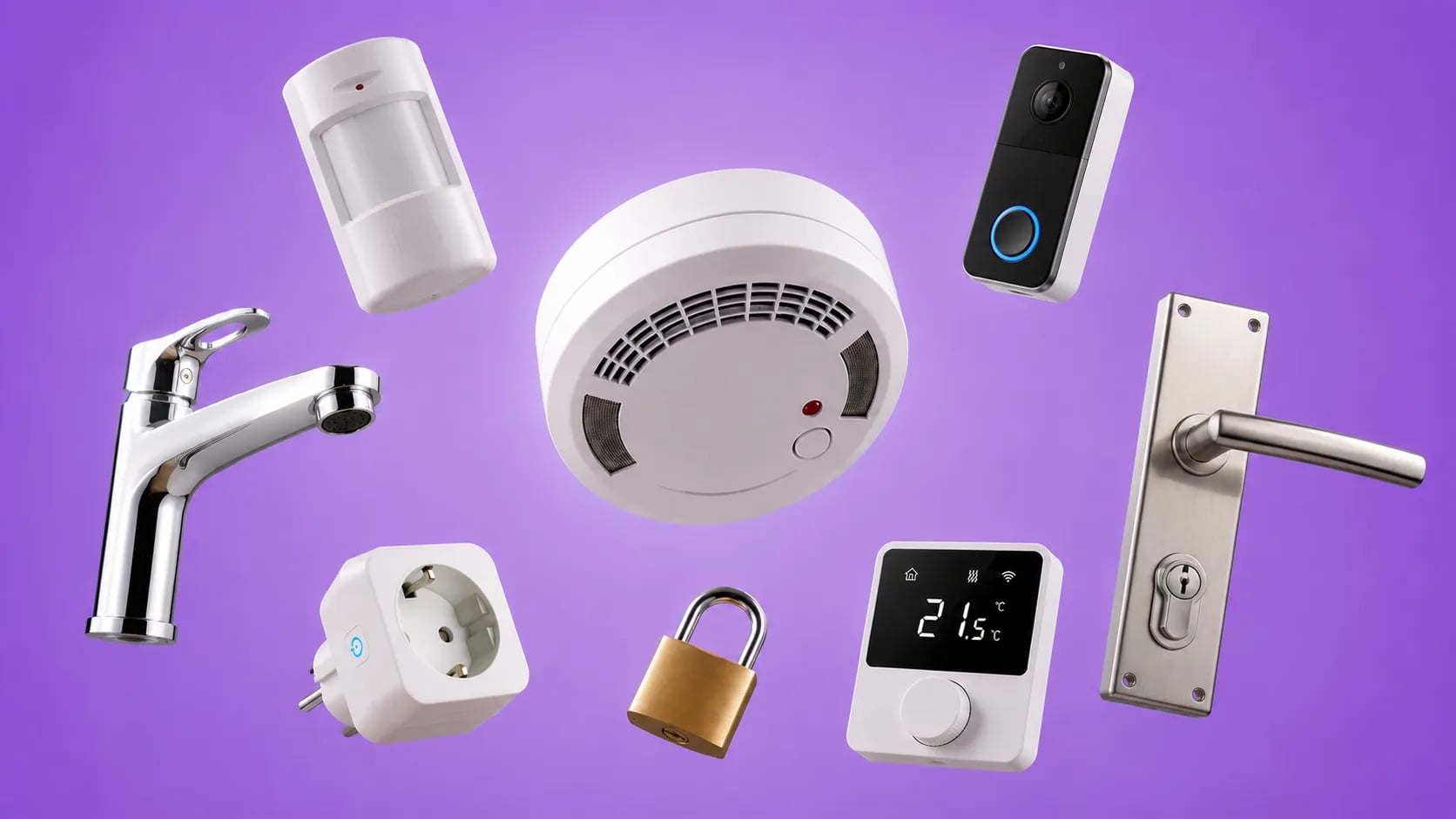
Home Safety: What Your Home Does for You
Behind every wall, outlet, and faucet, your home works tirelessly to protect you from everyday hazards. Whether it’s burglaries, burns, or electric shocks, here’s how it keeps dangers at bay so you don’t even have to think about them.
When it comes to burglars, your home is playing for time
Your doors and windows know that every second counts
How long does it take to deter a burglar targeting your home? Don’t know the answer? Don’t worry: your home has you covered, because it won’t give in—not even to the most persistent burglars.
It’s simple: it relies on the strength of its entry points. Every second a burglar spends trying to break into a door or window that doesn’t give way adds to the stress, noise, and uncertainty that eventually cause them to give up. That’s why, before they reach your home, doors and windows must first prove their worth in the lab by withstanding break-in attempts. Once tested, they are assigned a “resistance class” (RC).
Under real-world conditions, CR 2-rated doors and windows can withstand an attack by an opportunistic intruder armed with a tool such as a screwdriver for an average of three minutes.
CR 3-rated products can withstand an attack by a skilled burglar equipped with high-performance tools for five minutes. Doors and windows rated CR 4 through CR 6, on the other hand, can hold off experienced burglars equipped with powerful tools such as axes or electric drills for up to twenty minutes.
Materials that do not yield under pressure
If your home is able to thwart these break-in attempts, it’s because every component plays its part. Take window handles, for example: they’re made of materials hard enough to withstand a drill. And where ordinary glass would shatter, their windows are equipped with burglar-resistant glass.
: Did you know? 600 kg of pressure. That’s what your doors and windows are subjected to in the lab so they can hold out for five minutes against a burglar in real life.
Your electrical system: a powerful shield
A plastic case that could save your life
Detecting an electrical insulation fault and instantly cutting off the power before the danger reaches you—that’s the job of the “residual current device” (RCD). Despite its unassuming appearance as a simple plastic box, it acts as a bodyguard for your electrical system, keeping you safe from electrocution.
You have at least two of them in your home: if one stops working, the other takes over so that your protection is always guaranteed.
Circuits designed with millimeter precision
While RCDs keep you safe, they never work alone. The circuits in your home are precisely rated to prevent a conductor—that is, the wires that make up your electrical system—from overheating and catching fire if it becomes overloaded.
For your lighting, 1.5 mm² wires are sufficient, provided the current does not exceed 16 amps. However, high-power appliances such as ovens, dishwashers, etc., require heavier-gauge wires: 6 mm², capable of handling up to 32 amps.
The electrical panel: an unparalleled conductor
As for the main circuit breaker, it is the beating heart of your electrical system. It receives power from the utility grid, distributes it throughout your home, and can shut everything down in a fraction of a second in the event of an overload or emergency.
This circuit breaker is, in fact, one of the key components of the “home utility duct” (GTL), which brings together and organizes the input and output lines for all your electrical and communication systems.
: Did you know? Beneath the tiles in your bathroom, an invisible safety feature is keeping you safe. The electrical system there is divided into three zones to ensure that water and electricity don’t come into contact in a way that could be fatal. No electrical appliances are allowed in the bathtub or shower. Above them, only very low-voltage appliances are permitted, and within a 60-cm radius, the area is reserved for appliances that are very well insulated.
Drinking, washing, heating… without any risk
A valve to the rescue of drinking water
Do you like it cold? Room temperature? Flavored? Whatever your preferences, drinking water is part of your daily routine. It may seem like a simple act… but it’s actually quite significant: feeling safe at home also means being able to drink uncontaminated tap water.
That’s why drinking water systems are protected against “backflow” contamination. How does it work? Once discharged, wastewater—from lawns, toilets, and other sources—can’t flow back into your pipes, thanks to a check valve that directs the flow in the right direction.
The thermostatic mixer: your ally in preventing scalds
Here’s another example: you’re enjoying a well-deserved bath when suddenly the cold water stops flowing. The thermostatic mixer reacts instantly to prevent the water from scalding your skin. It allows only 200 ml to flow during the first five seconds, then 300 ml during the next 30 seconds—just enough time to stabilize the temperature. That’s barely a few drops of water, whereas a standard shower flow rate consumes between 10 and 15 liters per minute.
Under your feet, a floor that’s just the right temperature
A skin temperature between 42°C and 45°C is enough to cause burns. Fortunately, your heated floor never exceeds 29°C. This limit is designed to protect you and adapts to your lifestyle: whether you’re wearing shoes, barefoot, sitting, or standing, the temperature adjusts accordingly.
Did you know? : 99.999%. And to keep your floors, fabrics, and other surfaces from becoming breeding grounds for bacteria, the disinfectants you use at home must be 99.999% effective. Even the toughest germs don’t stand a chance!
Your home takes child safety seriously
Equipment designed to keep little explorers at bay
When it comes to your children’s safety, your home doesn’t cut corners. For example, have you ever wondered why your blender or kettle always has such a plain design? It’s so your children won’t mistake them for toys.
And because your kids love to stick their fingers everywhere, we even test these devices using a fake, articulated finger: grilles, slits… if the finger manages to fit through an opening carrying an electric current, the device fails the test.
The electrical outlets are equipped with small shutters that close automatically. This makes it impossible for a child to insert small objects such as paper clips or a needle into them.
Your little ones are in good hands—right down to the moment they drift off to sleep
In fact, the company looks out for your little ones right down to their beds. Duvets for children under 36 months? No cords, no ribbons—nothing that could wrap around a little neck. And when it comes to components, particularly buttons, only those that have withstood a pull force of 70 newtons—the equivalent of 7 kg—are permitted. The point? To ensure your child doesn’t swallow them.
As for temperature, the comforter doesn't get any warmer than a light cotton sheet. This way, it keeps your baby at the right temperature all night long, without the risk of overheating!
For the little ones, bassinet beds are like little fortresses: to prevent a baby from getting their head or a limb stuck, the space between two slats on the bed base must not be wide enough to fit a 6-cm cone.
: Did you know? A 50-kilo bag dropped from a height of 30 cm. That’s the impact your pool fence must be able to withstand to ensure that no child under the age of 5 can access the pool without supervision.
Conclusion
Behind every product mentioned here lies a standard. And behind every standard are dozens of experts who have come to an agreement—sometimes over the course of years—to define the maximum temperature a heated floor must not exceed, the impact a door must withstand, and the pathogens a disinfectant must eliminate. These guidelines are voluntary: no law requires manufacturers to follow them. Yet most do. Because that’s what you expect when you come home at night.
What if you wanted to learn more about the standards that protect your daily life?
The rules that ensure your safety
#1 Resistance Classes for Your Doors and Windows – Standard NF EN 1627-1630
#2 Ensuring the Safety of Your Electrical System – NF C15-100 Standard
#3 Drinking Water Quality – NF EN 1717 Standard
#4 A Properly Adjusted Thermostatic Mixing Valve – NF EN 11 Standard
#5 Control of Underfloor Heating – Standard NF EN ISO 11855
#6 The Efficacy of Disinfectants – NF EN 1276 Standard
#7 Safety of Household Appliances – NF EN 60335 Standard
#8 Child-Safe Electrical Outlets – NF C15-100 Standard
#9 Textiles Suitable for Infants – NF EN 16779 Standard
#10 Safe Cribs – NF EN 716 Standard
#11 Pool Fences That Children Cannot Climb Over – NF P90-306 Standard