
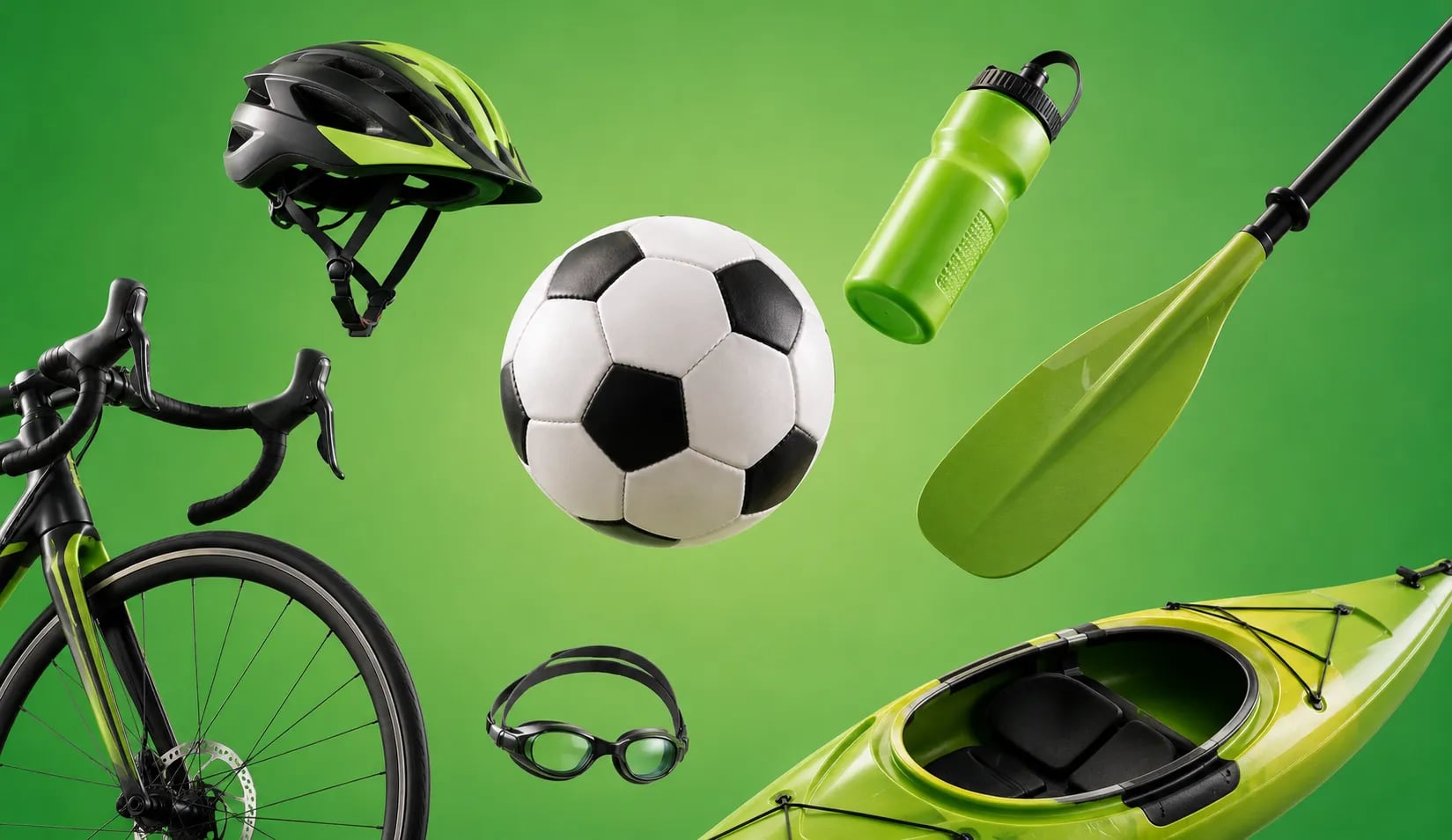
Sports: What You Don't Know (Yet) About Your Gear
Your bike helmet has survived dozens of simulated falls before ending up on your head. The soccer ball your child plays with always bounces just right, no matter who made it. None of this is a coincidence. Behind every piece of sports equipment lies a process of design, testing, and validation whose scope you can’t even begin to imagine.
The helmet: the item that helps you keep a cool head
From snow-capped peaks to climbing walls, there’s one piece of gear you never take off: your helmet. A helmet is like a carton of eggs that surrounds your head and absorbs impacts before they reach you. And every helmet undergoes a series of rigorous tests.
Let’s take a look at a bike helmet. Do you see the “chin strap”—that small, adjustable strap that goes under your chin? As small as it is, it’s what keeps the helmet securely on your head in the event of an impact. That’s why, in the lab, it has to withstand numerous drop tests without stretching too much or coming loose from the helmet.
And because every second counts, even the chin strap buckle undergoes testing: it must be able to be opened with one hand after a fall.
Whether you’re skiing in bright sunshine or freezing cold, does your ski helmet still perform just as well? There’s a reason for that: before it even reached your head, its durability was tested at extremely low temperatures, ranging from -25°C to +2°C. It also passed the artificial aging test with flying colors, having been exposed for several days to temperatures as high as +70°C.
When riding, a helmet protects you from falls and kicks, with reinforcements located mainly at the top and back of the head. Its hard shell distributes the impact, and its foam absorbs the energy. The result: in the event of an impact, the perceived force does not exceed 200 g. To achieve this result, at least twelve test helmets of the same class are put through their paces!
The ball: a bounce that’s not as ordinary as it seems
What would soccer games be without a ball that bounces before you can volley it? What’s the point of playing basketball if you can’t dribble anymore? A ball’s bounce is a serious matter. If it bounces too low, it flattens out like a pancake. If it bounces too high, it loses its bounce when it hits the ground.
So, to achieve the “perfect” bounce, the ball undergoes a “drop test.” It is dropped five times in a row in free fall onto a concrete slab. Concrete is the ideal judge: it’s rigid, neutral, and universal—you can find it everywhere.
What is the expected bounce height for a soccer ball during this drop test? Between 1.30 meters and 1.40 meters. A good basketball, on the other hand, should bounce between 1.025 meters and 1.075 meters. For each sport, if all five bounces are successful, the test is passed; otherwise, the ball fails!
: Did you know? If the ping-pong table in your backyard doesn’t warp in the rain, it’s because its tabletop has undergone eight days of testing: submerged in water for three days, dried for twenty-four hours, then submerged again twice in a row. This grueling process culminates in three hours of exposure to intense heat, to ensure it won’t warp even during a heat wave!
The ground beneath your feet: a well-designed playground
Where there’s a ball, there’s a field. And on the field, every square foot is the result of invisible yet essential work. In soccer, for example, the height of the blades of grass you walk on is determined using a disc about half a meter in diameter—the size of a large pot lid—that weighs barely more than a bar of chocolate.
Basically, the disc slides along a graduated rod placed vertically on the lawn and stops where the grass naturally holds it in place. The number marked on the rod at the point where the disc stops then determines the height of the grass. This test is repeated at least eight times for areas smaller than 100 m², between eight and 15 times for areas between 100 m² and 1,000 m², and up to 20 times for areas of 1,000 m² or larger.
You can't just wing it when it comes to lawn height!
In an athletics stadium, everything is designed so that no lane is steeper than another, which would give certain runners an advantage based on their position. If you place a glass of water on the track, you’ll see that the tilt of the liquid in the glass is almost imperceptible: this is a mark of quality.
We also check the thickness of the track surface, starting at the finish line and alternating between the even and odd lanes. The goal is to prevent you from running on a surface that’s too thin, which—like a worn-out shoe sole—doesn’t absorb shock well. Believe it or not, the quality of these surfaces makes all the difference.
: Did you know? To ensure that Vincent, a para-fencer, can roll along with ease, the floor of the piste must pass the “rollability” test. Rollability refers to the ability of the track surface to facilitate the movement of athletes’ wheelchairs without affecting the performance of able-bodied athletes. To measure it, a weighted wheel is rolled across the track surface. If it rolls neither too easily nor too slowly, it passes the test!
Body armor: science keeps you protected
Ah, that brightly colored life jacket that never leaves your side during your boat trips. Believe it or not, it passes the “buoyancy” test. In practical terms, a good life jacket is one that does the work for you: it turns you onto your back when you’re in the water, like a cork that floats to the surface. Without any effort on your part. In the lab, it has no more than five seconds to demonstrate this. After that, it’s out of the running!
With your cleats on, you’re running after the soccer ball. And then, disaster strikes. Your opponent has just kicked you in the left leg: a shin injury, and the game is over. That’s what could happen to you without shin guards. It must be said that behind their minimalist design lies a concentration of technology designed to withstand the impact of a 1-centimeter-diameter metal cleat—in terms of how it feels, it’s the equivalent of your bare foot crushing a Lego brick.
: Behind every piece of equipment you wear, put on your feet, or step on, there’s a standard. A document that no one reads when buying cleats or inflating a ball—and yet. It’s this standard that sets the acceptable bounce height, the sufficient foam thickness, and the minimum tear strength of a chin strap. These rules of the game are the result of a collective effort: experts from all walks of life who have worked together—sometimes for years—to agree on what is reasonably safe and effective for you. Want to know how these rules come about, and who writes them?
Each piece of equipment has its own set of rules:
#1 Bicycle Helmets – EN 1078 Standard
#2 Ski helmets – EN 1077 standard
#3 Equestrian Helmets – EN 1384 Standard
#4 Ball Bounce – EN 12235 Standard
#5 The Ping-Pong Table – EN 14468-1 Standard
#6 The soccer field – EN 12233 standard
#7 The Track and Field Track – P90-100 Standard
#8 Indoor Sports Flooring – P90-151 Standard
#9 Life jacket – EN ISO 12402-1 standard
#10 Shin guards – EN 13061 standard